Our Director, Fergus Feilden, is looking forward to speaking at ‘Pioneering the Potential 2024’, a Wood & Natural Materials Micro-conference hosted by Fourth Door Research @fourth_door
The talks will be held at the Depot Cinema & Restaurant in Lewes from the 18-20 September. Fergus will present a range of Feilden Fowles’ completed and upcoming projects, focusing on those built with earth-based techniques. To join, head to Fourth Door’s website.
Fergus’ passion for socially and environmentally responsible architecture is born out of a love for the natural world, his enjoyment of low-tech design and using natural materials. Over the last fifteen years, Feilden Fowles have been redefining the British architectural scene, pursuing a low-tech, crafted and authentic materials led design ethos. Working across the education, heritage, arts and cultural sectors, recent projects have included the Dining Hall at Homerton College, Cambridge, the Weston at Yorkshire Sculpture Park, and the Urban Nature Project at the Natural History Museum. Our current project at Black Robin Farm, near Lewes, is a new arts and education centre and eastern gateway to the South Downs National Park for Towner Eastbourne and Eastbourne Borough Council.
The symposium on 3-4 October will be bringing together some of the most innovative, creative and acclaimed people working in sustainable Architecture and Landscape Architecture today.
The programme of talks, demonstrations, tours and group discussions has been designed to deepen our understanding of using earth as a sustainable material and of the fundamental processes, benefits and techniques we can integrate into our own practices.
We’re delighted that the Dining Hall at Homerton College, has been selected as one of 15 nominations for the DETAIL Award 2024. Please support us by voting for the project on their website – follow the link here.
“On July 2, 2024, the jury of the DETAIL Award selected their favorites for the DETAIL Readers’ Award from an impressive array of submitted projects. The nominated projects were chosen for their outstanding architectural quality and exemplary character. Neither the size nor the height of the construction budget played a role. Instead, the focus was on a convincing overall concept, a consistently implemented sustainability strategy, successful details, and a coherent choice of materials.
The DETAIL Readers’ Award is given to the project most favoured by DETAIL readers. The winner is selected through an online voting process hosted on detail.de from 1 August – 1 October 2024.
The winner will be announced at a festive award ceremony on December 2 in Munich.”
“The museum’s newly transformed gardens are a collaborative triumph, offering a walk through geological time in a landscape of ancient rocks and Jurassic planting that’s a haven for wildlife, Londoners and dinosaurs alike.”
To read this review on the Observer’s website, click here. Feilden Fowles led the transformation, working in collaboration with landscape architects J&L Gibbons and alongside Gitta Gschwendtner, engineersHRW and Max Fordham.
The transformed outdoor space at the Natural History Museum opened this morning, unveiling five acres of gardens telling the story of evolution on our planet, from 2.7 billion years ago to the present day. Feilden Fowles led the transformation, working in collaboration with landscape architects J&L Gibbons and alongside Gitta Gschwendtner, engineersHRW and Max Fordham.
Driven by an ambition to conserve and enhance biodiversity across the site and working closely with the Museum’s expert scientists, the team developed a holistic plan which sensitively incorporates two new timber and stone buildings: the Nature Activity Centre supported by Amazon Web Services; and the Garden Kitchen, into a landscape of accessible outdoor living galleries, which provide a sequence of opportunities to learn about and explore urban nature, and the incredible diversity of life on Earth.
Respecting the heritage of the Museum’s iconic Grade 1 listed building, designed by Alfred Waterhouse and dubbed the ‘Cathedral to Nature’, has been a core guiding principle. Waterhouse arranged the Museum with past (extinct) nature in the east wing and present (living) nature in the west, an idea echoed in the thematic arrangement of the gardens. The Evolution Garden in the east tells the story of Deep Time, through The Evolution Timeline, supported by Evolution Education Trust, representing the strata of our geological landscape. A new learning landscape in the west, the Nature Discovery Garden supported by The Cadogan Charity, showcases the broad range of UK habitat types present today and future approaches to climate adaptation.
Bringing history to life, this immersive and awe-inspiring landscape is part of a national programme of activity aiming to inspire people, in particular young people, to fall in love with nature and become the naturalists of the future.
“For this to truly be an ambitious and pioneering project, this needed to be a collaborative effort, drawing in expertise, advice and input from inside and outside the Museum. We visited other gardens, learning spaces and ecology centres; we spoke to scientists, conservationists, geologists; we learned from our communities, teachers, families and accessibility experts and we tendered for the best design team who were equally inspired to deliver a sustainable, accessible and biodiverse-friendly design.” – Natalie Tacq, Urban Nature Project Programme Manager, Natural History Museum
“It has giddying cliffs, three-billion-year-old rocks, a prehistoric forest – and a giant bronze dinosaur called Fern. Our writer hurtles back through millennia as the beloved museum’s five-year revamp comes to fruition.”
To read Oliver Wainwright’s review of the transformed outdoor space at the Natural History Museum, click here.
The Dining Hall at Homerton College, Cambridge has won a National RIBA award!
Many thanks to the jury and our brilliant client for their passion and dedication during this process. “A young(ish) Cambridge college took a chance on a young architectural practice with big ambition and an even bigger heart. The result is a building that is a triumph of intelligent design with deep social, cultural, and environmental purpose.” – Vice Principal, Dr Francesca Moore.
Congratulations to the fantastic team involved and everyone who has contributed to the project from competition through to completion – and beyond. Thanks also to our publicist Claire Curtice and her wonderful team for their support.
We’re delighted to have been featured in Rowan Moore’s article in the Observer highlighting the Dining Hall, Homerton College, as one of his recommendations for this year’s RIBA Stirling Award shortlist “..its design playing a game of heft and lightness between the skinny timber frame of its interior and the substantial-looking deep green faience on the outside.” Following success at the Regional Awards in May, we’re keeping everything crossed for Rowan’s predictions to come true for the fantastic client, design team, contractor and everyone involved in the project. Read the full article on the Guardian Website by clicking here.
This week, we’re placing a spotlight on our project at Black Robin Farm, a retrofit and refurbishment of this historic farmstead, which seeks to preserve the agricultural character of the existing buildings and their unique setting, while extending the campus to include a new flexible art gallery and events space.
The new gallery building is located on the northern side of the track and is formed of three distinct gallery volumes, rendered in lime and flint. The monopitch roofs follow the fall of the land, provide north-lit galleries and optimal orientation for photovoltaic panels. Internally, the gallery spaces have been designed in collaboration with Towner to create flexible, simple and raw spaces for art; one of the galleries is designed as a climate-controlled space and the other two are designed to GIS standards.
Our director Fergus Feilden will be joining RCA Alumni on Tuesday 28 May for a series of intergenerational conversations. As well as presenting a number of Feilden Fowles’ projects, he will be documenting his journey since graduating the RCA, using image and sound, alongside other guests Jane Hall (Assemble), Stephanie Macdonald (6a) and Sohanna Srinivasan.



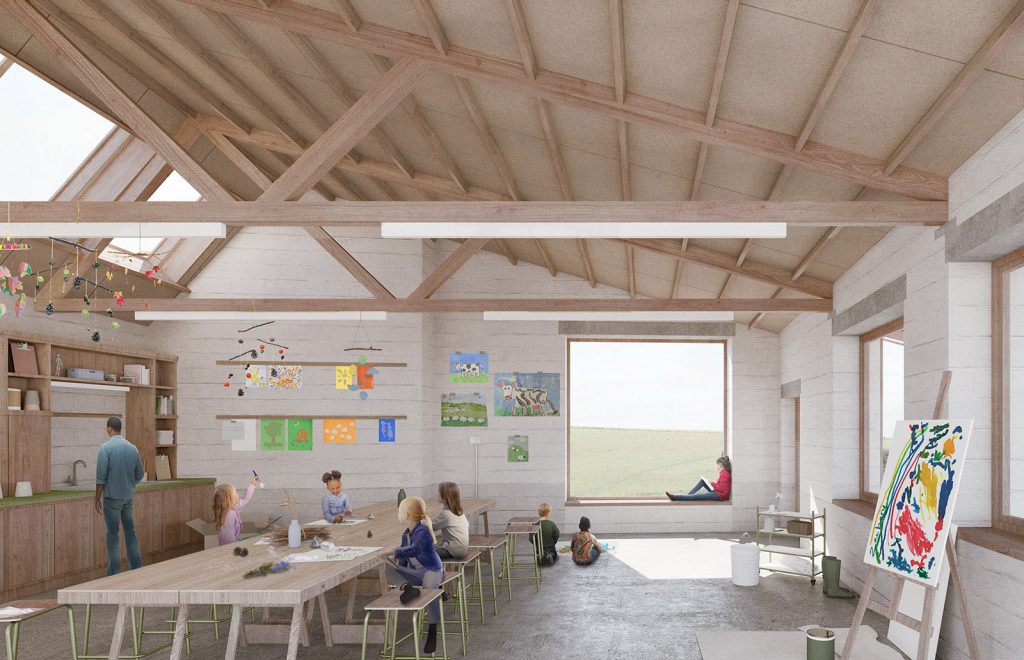 This week, we’re placing a spotlight on our project at Black Robin Farm, a retrofit and refurbishment of this historic farmstead, which seeks to preserve the agricultural character of the existing buildings and their unique setting, while extending the campus to include a new flexible art gallery and events space.